


The Recovery Gap: Why Athletes and High Performers Are Looking Beyond Supplements

The thing serious athletes figured out first
There’s a moment every high performer eventually hits.
You’ve done the work. You train consistently. You eat well. You sleep — or you try to. You’ve dialed in your protein, your creatine, your electrolytes, your sleep tracker, your cold plunge, your mobility routine. On paper, you’re doing everything right.
And yet the thing that limits your progress isn’t the workout itself. It’s what happens between workouts.
The session doesn’t break you. The accumulated debt from sessions that haven’t fully resolved is what breaks you. The nagging shoulder that won’t quiet down. The hamstring that’s been tight for six months. The week where you stacked three hard days and your body is still, somehow, paying for it.
This is the recovery gap. And once you notice it, you can’t un-notice it.
The evolution of the performance stack
Walk into any serious training environment and look at what people are actually using. The stack has evolved in a very specific direction over the last twenty years.
First wave: macronutrients. Protein powders, carbs, calories. The foundational insight that you can’t out-train poor nutrition.
Second wave: targeted supplements. Creatine, beta-alanine, caffeine, electrolytes, omega-3s. Compounds with genuine research behind them, used to support specific performance outcomes.
Third wave: sleep and stress. The recognition that recovery isn’t just about fuel — it’s about the nervous system. Tracking HRV, managing cortisol, protecting sleep as the non-negotiable foundation of training adaptation.
Fourth wave: what’s emerging now. A deeper look at the actual biology of repair. Tissue signaling. Inflammatory regulation. Growth hormone pulsatility. Cellular-level recovery. This is the space peptide research occupies — and it’s the space serious high performers have been quietly exploring for years.
Not as a shortcut. Not as a replacement for the fundamentals. As the next layer of the same question: how does the body actually repair itself, and what does that process depend on?
What the science is actually looking at
Recovery, at the biological level, is not a single process. It’s several overlapping systems working in coordination.
Tissue repair. When you train hard, you create controlled micro-damage in muscle, tendon, and connective tissue. Your body responds with an inflammatory cascade, followed by a repair phase, followed by adaptation. This process involves dozens of signaling molecules — growth factors, cytokines, and yes, peptides — working in sequence.
Protein synthesis. Your body needs to build new tissue faster than it’s breaking it down. This depends on nutrient availability, hormonal signaling (particularly growth hormone and IGF-1), and the cellular machinery that actually assembles proteins.
Inflammation regulation. Acute inflammation is how repair starts. Chronic inflammation is what prevents it from finishing. The body’s ability to resolve inflammation — not eliminate it, but complete it — is central to whether training produces adaptation or accumulation.
Nervous system recovery. The autonomic nervous system shifts between sympathetic (stress, performance) and parasympathetic (rest, repair) states. Training is a sympathetic load; recovery requires parasympathetic dominance. This is why sleep and stress management aren’t optional for serious athletes — they’re the substrate repair runs on.
What researchers have been asking, for decades now, is whether specific peptides can support these underlying systems. Not override them. Not shortcut them. Support them.
The peptides inside the research conversation
At Feel Peptides, we organize peptides involved in recovery, resilience, and physical performance pathways under the Feel Performance category. A few of the most studied areas worth understanding:
BPC-157. One of the most researched peptides in the tissue repair space, originally identified from a protein sequence found in gastric juice. The body of research exploring its role in tendon, ligament, and soft tissue signaling is substantial and still expanding. It remains a research compound, and no product is approved for human use — but the literature is worth engaging with if you’re curious about how tissue repair signaling is being studied.
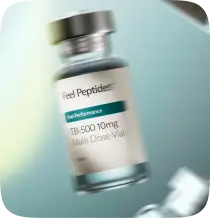
TB-500 (Thymosin Beta-4 fragment). A peptide investigated for its role in cellular migration and tissue remodeling. Research has explored its involvement in the coordination of cells involved in wound healing and tissue regeneration. Like BPC-157, it sits squarely in the research domain.
Growth hormone secretagogues (Sermorelin, CJC-1295, Ipamorelin, Tesamorelin). This family of peptides has been studied for how they interact with the body’s natural growth hormone release. The relevant distinction is that they aren’t growth hormone themselves — they work with the body’s pulsatile signaling rather than overriding it. The research base around this class of peptides is among the most established in the field.
Restore (BPC) and Rebuild (BPC/TB combinations). Within the research literature, some of the most interesting work has explored how these peptides may interact when studied together — particularly in contexts of soft tissue signaling and the cellular mechanisms of repair.
None of these are treatments. None of them replace the work. But for anyone paying attention to the frontier of recovery science, this is the conversation that’s actually happening — and it’s worth understanding clearly, rather than through the fragmented version you see in forums and social media.
What this isn’t
It isn’t a promise that peptides will fix your recovery. Recovery is built on fundamentals — sleep, nutrition, load management, stress, consistency — and no peptide research changes that. If you’re not sleeping seven hours, no signaling molecule will rescue you.
It also isn’t a suggestion that harder is better. The entire premise of understanding the recovery gap is that training is already hard enough — what most high performers actually need is better repair, not more stress.
And it isn’t a shortcut. The serious athletes who pay attention to peptide research are not the ones looking for a hack. They’re the ones who have already done the fundamentals for years, noticed the gap, and started asking deeper questions about the biology underneath it.
That’s the mindset this work is for.
The Feel Performance lens
We built the Feel Performance category around one idea: recovery, resilience, and physical output aren’t separate goals. They’re the same system, seen from different angles.
If you’re performing at a serious level — as an athlete, a coach, a clinic working with performance-focused clients, or just someone who refuses to accept that feeling depleted is the cost of being driven — you already know that the real edge isn’t in working harder. It’s in recovering better.
The research into how peptides support tissue signaling, inflammatory resolution, and growth hormone pulsatility is one of the most active frontiers in that conversation. It’s not the whole answer. It’s a layer of the answer that serious performers are no longer willing to ignore.
Train hard. Recover harder. Understand the biology.
That’s the version of this we think is worth telling.
About the author
Stephen Brudzewski is the Founder and CEO of Feel Peptides, a U.S.-based peptide solutions company committed to making advanced science feel familiar, approachable, and part of everyday life. He writes about the research, the framework, and the philosophy behind Feel Peptides.
Disclaimer
The information in this article is provided for educational and informational purposes only. Feel Peptides products are designated for research use only and are not intended for human consumption, nor to diagnose, treat, cure, or prevent any disease. Nothing in this article constitutes medical advice. Always consult a qualified healthcare provider before making decisions about your health.